
Did you know the majority of your nutrient intake occurs through breathing? Did you know the brain associates belly breathing with relaxation and chest breathing with anxiety?
Breathing is essential and activates all your energy systems, both in the physical body and the spirit body.
“40 days without food, 4 days without water, 4 minutes without oxygen” certainly highlights its importance.
Breathing should not be forceful, as to cause hyperventilation. Rather, breathe just deep enough to sense movement in the region of the body with which you are connecting.
The diaphragm is the most efficient muscle of breathing. It is a large, dome-shaped muscle located at the base of the lungs. Your abdominal muscles help move the diaphragm and give you more power to empty your lungs.
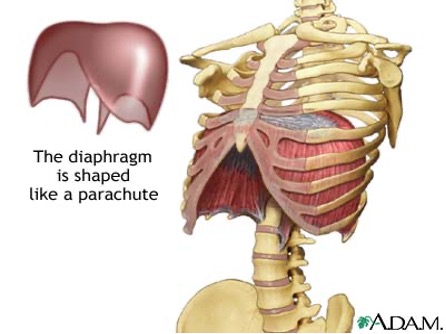
When we breathe, this dome-shaped muscle contracts allowing a reduced pressure in the upper body so that air may enter the lungs and provides tension across the top of the abdominal area.
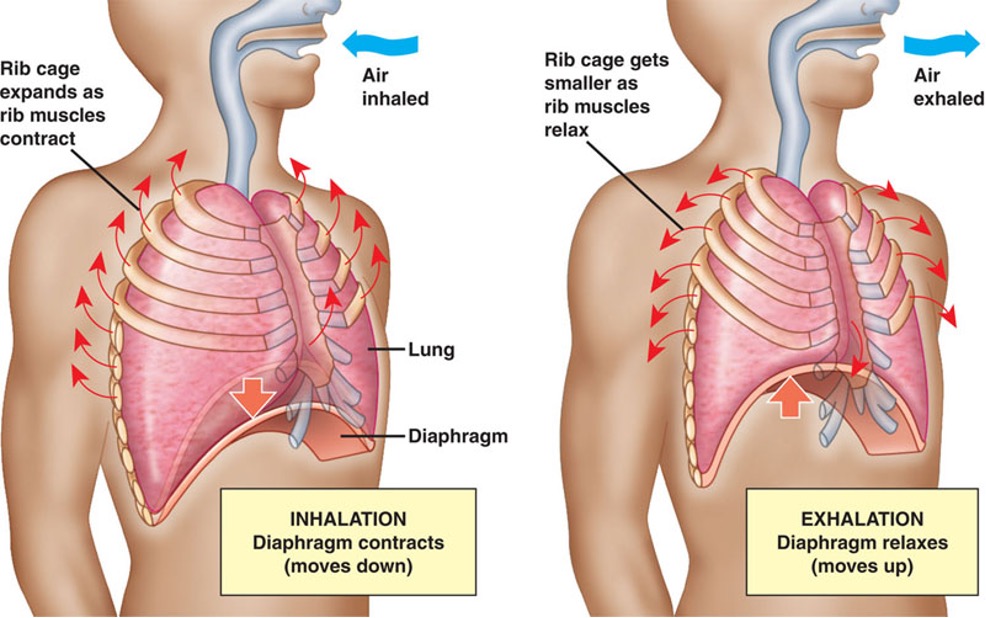
As we breathe in, we should see the stomach rise slightly as the dome contracts and compresses the abdominal space. As we breathe out, both the chest and the stomach fall. If you look at young children, this is what you usually see.
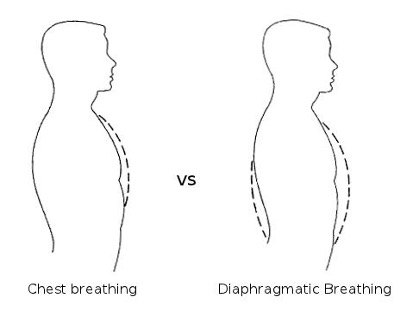
I often see exactly the opposite in adults. Their chest rises as the intercostal muscles contract. Yet, the stomach is drawn in by activation of the transverse abdominis muscle and the diaphragm is not engaged. Whilst this might present a more pleasing profile in a mirror, it reduces the volume of oxygen available by only partially expanding the lungs. This also results in weaker core stabilization.
When chest breathing like this the accessory neck and chest muscles must then assume an increased share of the work of breathing. This can leave the diaphragm weakened and flattened, causing it to work less efficiently, whilst also over activating muscles in the neck, shoulders and chest.
Chest breathing at rest causes lymphatic (waste removal) stagnation in the stomach, pancreas, spleen, liver, kidneys, large and small colon, and other organs.
Primary Cause of Abnormal Breathing
Conscious breathing eases over-stimulation of the autonomic nervous system, and lowers tension, allowing rebalancing to occur. Breathing is a doorway to releasing emotions that cause tension and body pain. The brain associates diaphragmatic belly breathing with relaxation and chest breathing with anxiety. Chest breathing, is a physiological response to avoiding FEAR. Fear is stored primarily in the abdomen region.
What Is Fear?
FEAR = False Emotions (Expectations) Appearing Real
There are 3 Forms of fear – Freeze, Flight or Fight
Freeze – The result of terror state, usually due to childhood terror, being unable to escape
Flight – The result of trying to get away from the underlying emotion, sense danger and we flee
Fight – Usually the result of not being able to flee, fight in anger or rage
Fears must be felt, not analysed intellectually, but physically and emotionally felt as a bodily experience
What Does Fear Cause?
Fear causes us to base our future decisions on what happened in the past
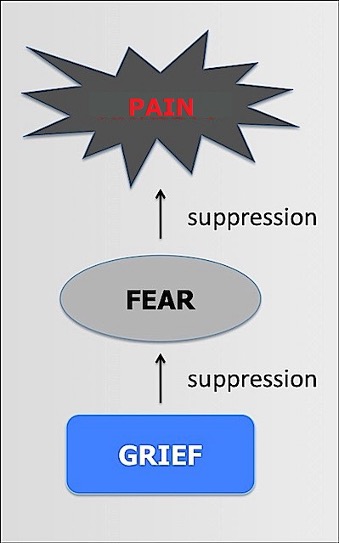
Fear is usually the cause of all anger (even childhood anger is the result of childhood fear of emotions)
Fear prevents us from emotionally accepting the Truth (Absolute Truth/ God’s Truth) and living a life grounded in Love
Fear prevents us from being able to exercise our desires in a pure manner
Fear causes us to “bury our head in the sand”
Fear causes all physical pain
Why Do We Fear?
Fear is the result of not emotionally understanding God’s Truth
Fear is the result of emotionally believing lies; fear is false emotions appearing real to us
Fear is the result of not loving our emotional pain – rather preferring to deny, excuse, blame or justify its existence
It is almost impossible to intellectually avoid fear without emotionally closing yourself down completely – that is if you shutdown feeling one emotion, it automatically suppresses all other emotions; love, joy, desire, pleasure and happiness included
All fear we feel now is the result of unexpressed old emotional experiences
How Does Fear Affect Breathing?
When we retain the emotion of fear in our soul, rather than feeling and releasing it, it becomes ‘frozen-like’, resulting in energy that cannot flow through our soul. Since the soul governs and controls everything that happens in the soul’s appendages, the spirit body and physical body, the energy that feeds through to the two bodies is also diminished
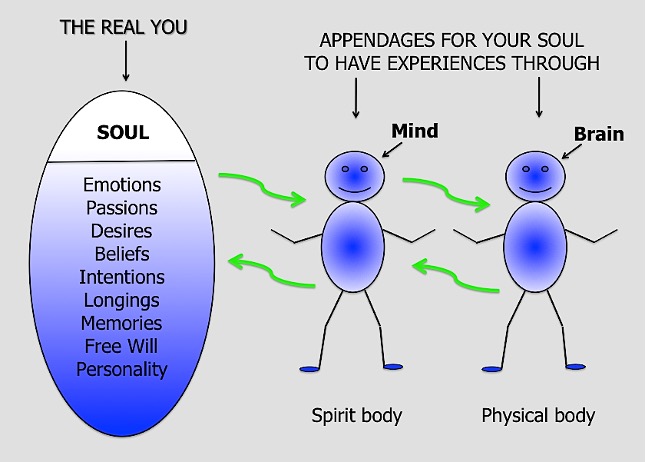
The Freeze state of fear, directly impacts the brain and autonomic nervous system, and then function of the dome-shaped diaphragm muscle. Further to this, avoidance of feeling past fears creates a cascade of events that result in chest breathing and poor cell regeneration, hence our aging over time.
Diaphragmatic Breathing
Diaphragmatic breathing is intended to help you use the diaphragm correctly while breathing to:
- Access and Release stored unfelt fear, the cause of physical and emotional pain
- Assist emotion to flow
- Stay connected with your body, become aware of ignored body pain
- Strengthen the diaphragm & core stabilisation
- Decrease the work of breathing by slowing your breathing rate
- Decrease oxygen demand – chest breathing and anxiety requires much more oxygen
- Use less effort and energy to breathe
- To help bowel and bladder function, removal of waste products.
- To perform lymphatic drainage of the lymph nodes from the visceral organs. The diaphragm is a lymphatic pump, and about 60% of all lymph nodes in the human body are located just under the diaphragm, so it is very important to breathe effectively.
Diaphragmatic Breathing Technique:
- Lie on your back on a flat surface or in bed, with your knees bent and your head supported. You can use a pillow under your knees to support your legs. Place one hand on your upper chest and the other just below your rib cage. This will allow you to feel your diaphragm move as you breathe.
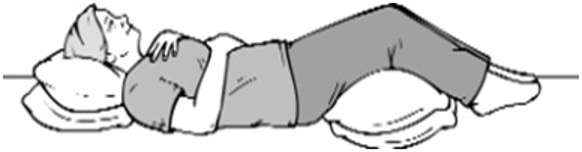
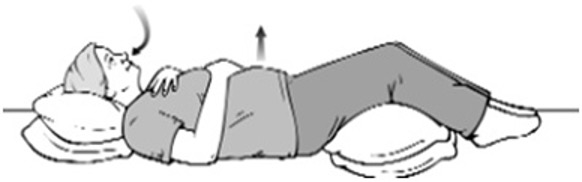
- Breathe in slowly through your nose so that your stomach moves out against your hand. The hand on your chest should remain as still as possible.
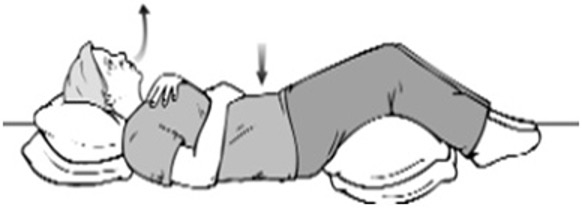
- Tighten your stomach muscles, letting them fall inward as you exhale through lips. The hand on your upper chest must remain as still as possible.
When you first learn the diaphragmatic breathing technique, it may be easier for you to follow the instructions lying down, as shown on the first page. As you gain more practice, you can try the diaphragmatic breathing technique while sitting in a chair, as shown below.
To perform this exercise while sitting in a chair:
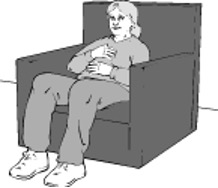
- Sit comfortably, with your knees bent and your shoulders, head and neck relaxed.
- Breathe in slowly through your nose so that your stomach moves out against your hand. The hand on your chest should remain as still as possible.
- Place one hand on your upper chest and the other just below your rib cage. This will allow you to feel your diaphragm move as you breathe.
- Tighten your stomach muscles, letting them fall inward as you exhale through pursed lips The hand on your upper chest must remain as still as possible.
Note: You may notice an increased effort will be needed to use the diaphragm correctly. At first, you’ll probably get tired while doing this exercise. But keep at it, because with continued practice, diaphragmatic breathing will become easy and automatic.
How often should I practice this exercise?
At first, practice this exercise 5-10 minutes about 3-4 times per day. Gradually increase the amount of time you spend doing this exercise, and perhaps even increase the effort of the exercise by placing a book on your abdomen.
Note: Slow breathing, such as during meditation or yoga, can be used to detune us from our emotions, rather than engage them. Make your breathing practice purposeful.
However, if we allow ourselves to breathe diaphragmatically, in other words we breathe from our abdomen rather than our upper chest, then this helps emotions to flow.
We can enhance the flow of emotion with our breath by doing the following exercise.
While standing upright, exhale as you allow the top half of your body to flop down and bend forward, while at the same time allowing your arms to flop down towards your feet.
Inhale as you rapidly move back to upright with your arms stretched above your head. Repeat for five to fifteen minutes.
You will most likely feel dizzy and light headed, or nauseous – this occurs often when first beginning to release the emotions that are locked up inside of us.
Lie down and continue to diaphragmatically breathe. Stay connected to your body, and allow the feelings to flow through you. Tremoring and shaking may occur at this time, which is excellent. Continue to breathe and allow the shaking to move throughout your body unimpeded. Give yourself time to breathe, connect and feel.
For more specific information about the importance of feeling and releasing emotion see Divine Truth and TRE Stress, Tension and Trauma Release Free Online Resources

